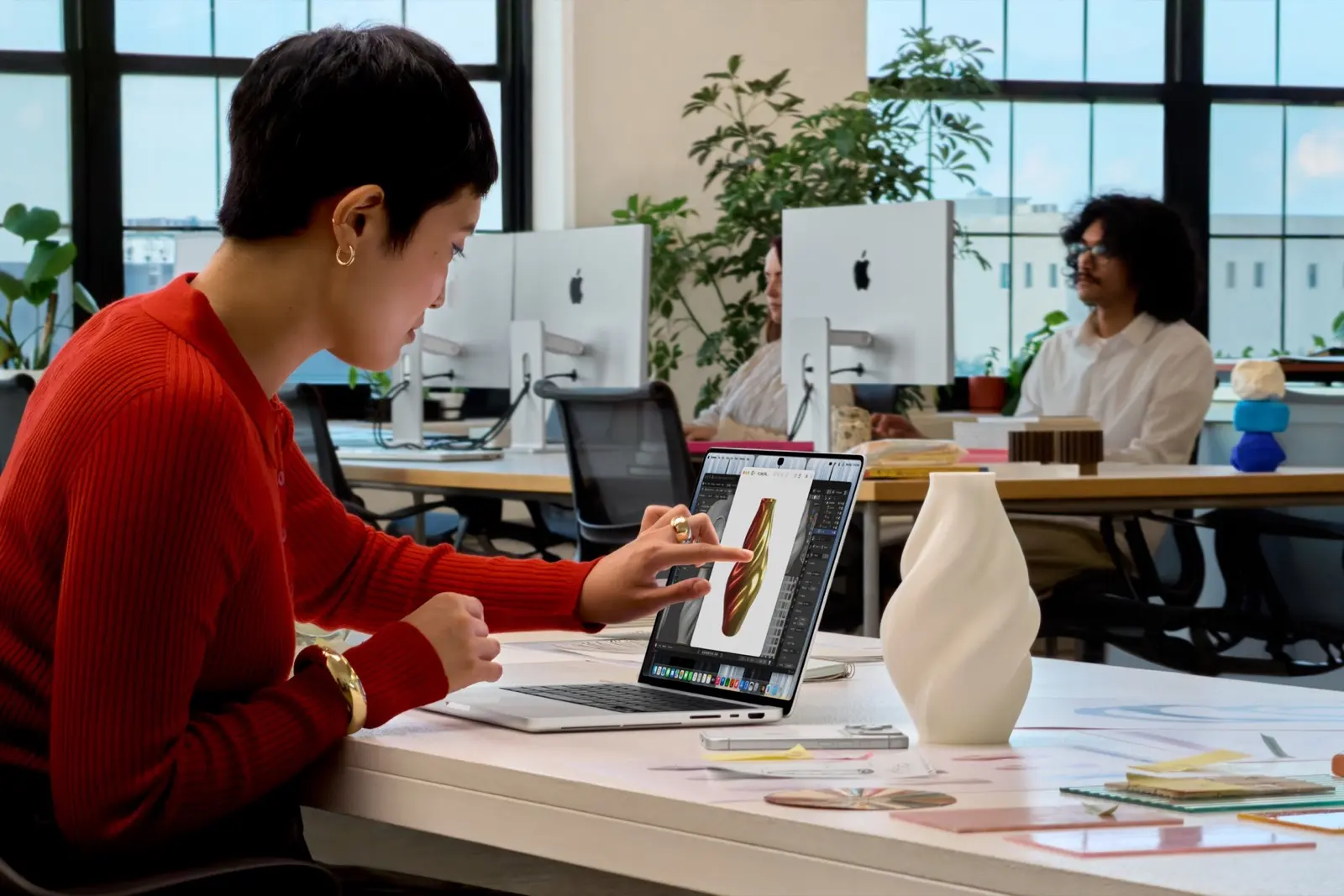
Apple has put a touchscreen on the Mac. On 28 October the company introduced a new MacBook Pro in 14- and 16-inch sizes with a tandem OLED display it calls PROLED XDR, and, for the first time on any Mac, touch input on the screen. The notch at the top of the display is replaced by the Dynamic Island from the iPhone, which now holds Spotlight search, Live Activities and Siri AI, according to Apple's announcement.
The new models sit above the MacBook Pro Apple released in March, which stays on sale at its current price, 9to5Mac reports. The 14-inch model with the M5 Pro chip starts at $2,899 and the 16-inch at $3,399. With the M5 Max chip, prices start at $4,499 and $4,799. Pre-orders opened on 28 October in 30 countries and regions, and the first machines reach customers on 6 November.
How touch works on a Mac
Apple has not turned the Mac into an iPad. Touch is an extra way to work alongside the keyboard and trackpad. You can scroll a web page with a swipe, pinch to zoom on a photo, drag slides between presentations, double-tap a window to fill the screen or flick it to tile it into place. The touch sensor is built into the display panel rather than laid on top of it, which Apple says reduces lag.
Existing apps work with touch from day one because macOS turns a touch into a click, according to Apple. Developers get new gesture tools to go further, and Apple names Microsoft Word, Excel, PowerPoint and Outlook, Canva, Notion, Zoom, Adobe Lightroom, DaVinci Resolve and Blender among the apps that will support touch. In Logic Pro, musicians can play an on-screen keyboard; in Final Cut Pro, editors can mark ranges and drop clips with a finger.
Apple also had to fix the problem that has dogged touchscreen laptops for years: a screen that wobbles when you press it. The company says a redesigned hinge keeps the display steady, and that video stabilisation smooths the camera feed if you touch the screen during a video call.
 More from AI and Tech StakSafaricom Fired 118 Staff Over Fraud Last YearSafaricom's new sustainability report shows 118 fraud dismissals and twice as many police referrals, but not what the staff did or who lost money.
Lighter, brighter, same chips
- The 14-inch model weighs 3 pounds, half a pound less than before, and the 16-inch weighs 4 pounds, 0.7 pounds less, according to Apple.
- Peak brightness rises to 2,000 nits for both HDR and SDR content, from 1,600 nits for HDR on the previous model, 9to5Mac reports. Apple claims a 10,000,000:1 contrast ratio.
- The chips are the M5 Pro and M5 Max already used in the March models, with up to 128GB of memory and, for the first time, up to 16TB of storage.
- Apple claims up to 24 hours of battery life. There is Touch ID but no Face ID, and no model with built-in cellular data, 9to5Mac notes.
Why Apple changed its mind
Apple held out against touchscreen laptops for years, arguing that reaching up to the screen tires the arm, CNBC reports, while rivals running Windows sold them. John Ternus, Apple's new chief executive, told WIRED that "the Mac is first and foremost an indirect input device", and that Apple "needed to get to a point where adding touch didn't make the product lesser in any way", as MacRumors reports. In his account, OLED made that possible: the thinner display stack let Apple add touch without making the laptop heavier or thicker.
Hardware chief Johny Srouji told WIRED that displays, Apple's chips and its software had matured enough to meet the company's bar, and marketing chief Greg Joswiak said professional users had been waiting for touch and that young creators now expect it, MacRumors reports.
- Apple Newsroom: Apple unveils groundbreaking MacBook Pro with PROLED XDR Display
- 9to5Mac: Apple announces all-new MacBook Pro with PROLED XDR display, its first touchscreen Mac
- MacRumors: Apple executives explain why the MacBook Pro finally has a touch screen
- CNBC: Apple brings touch to the Mac, reversing years-old stance on touchscreen laptop
- MacRumors: Apple reportedly announcing new MacBook Pro with OLED touchscreen on Wednesday